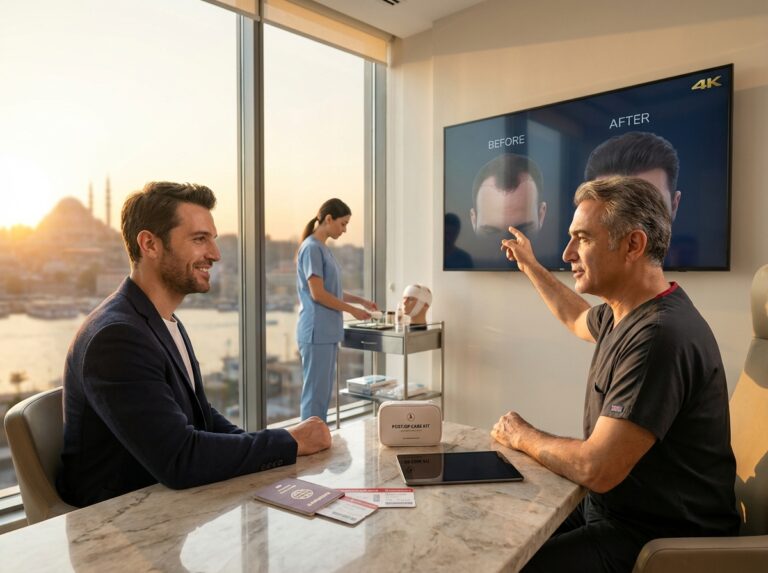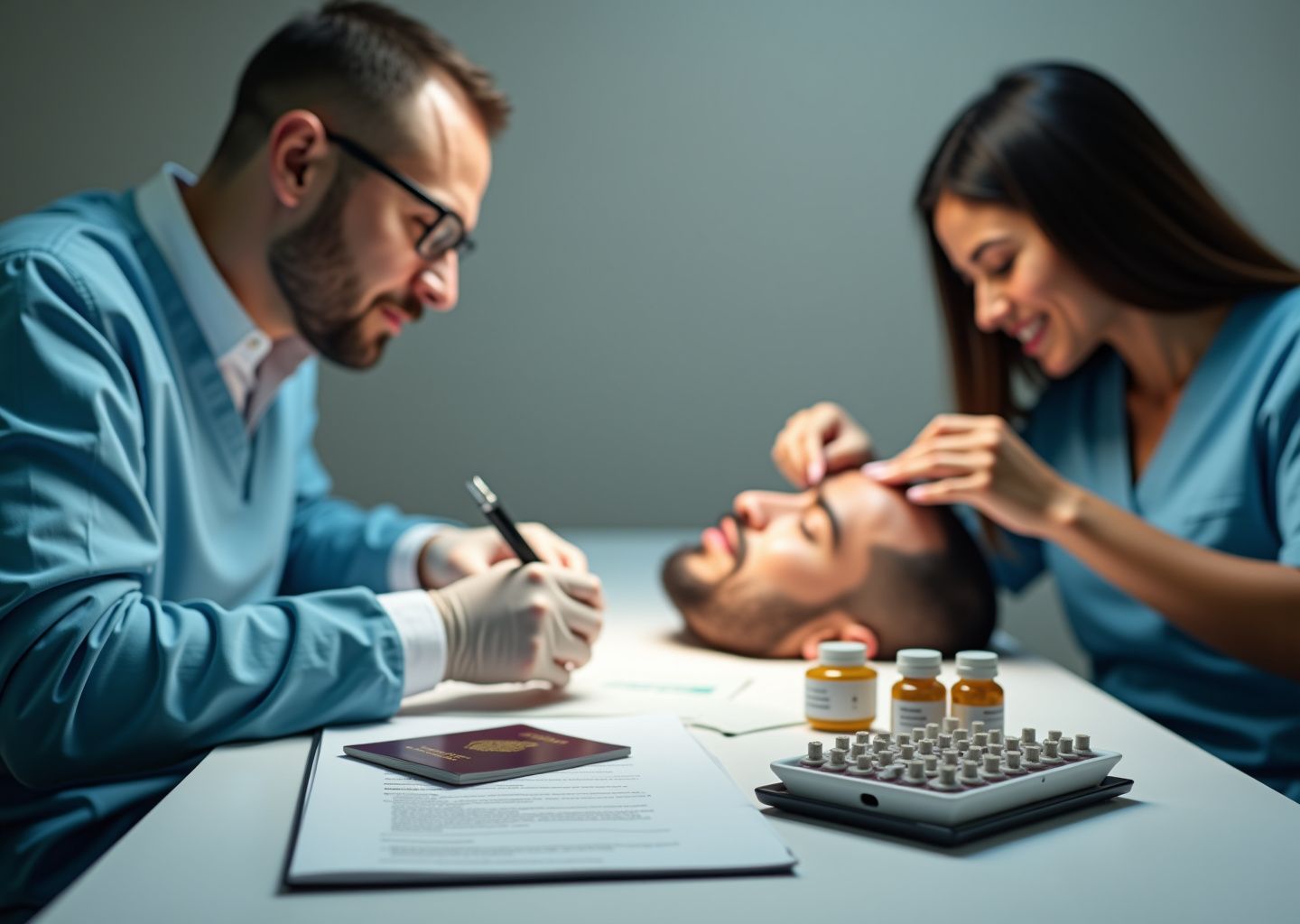
Deciding between FUE and DHI hair transplant techniques is a common dilemma for patients considering surgery at home or abroad. This article compares how each method works, expected outcomes, costs, recovery timelines, and how to plan a safe and cost‑effective plastic surgery trip overseas. Use the guidance to choose the right technique and travel plan for your goals.
How FUE and DHI Work and Who They Help
Most patients assume the difference between FUE and DHI lies in how hair is taken from the back of the head. The reality is different. Both methods use the exact same extraction technique. The real distinction happens during the implantation phase. Understanding this mechanical difference is the only way to decide which tool suits your specific level of hair loss.
The Mechanics of FUE (Follicular Unit Extraction)
FUE remains the most common procedure globally. Statistics from the Wimpole Clinic in 2025 show that 66.2% of all hair transplant surgeries use this method. The process involves three distinct steps.
First, the surgeon uses a motorized punch tool to isolate individual follicular units from the donor area. These punches are microscopic, usually between 0.7mm and 0.9mm in diameter. Once the grafts are separated from the surrounding tissue, the medical team extracts them with forceps and places them in a holding solution.
The second step defines FUE. The surgeon creates thousands of tiny incisions or “channels” in the recipient area. In 2025, most top-tier clinics use Sapphire blades for this step rather than steel blades. Sapphire tips are sharper and create V-shaped channels rather than U-shaped ones. This reduces tissue trauma and allows for denser packing.
Finally, technicians manually place the harvested grafts into these pre-made channels using forceps. This method requires handling the graft bulb directly.
The Mechanics of DHI (Direct Hair Implantation)
DHI modifies the implantation phase to combine incision and placement into a single action. The extraction phase remains identical to FUE. The difference begins once the grafts are out of the scalp.
Technicians load each individual graft into a hollow needle connected to a plunger device known as a Choi implanter pen. The surgeon inserts the needle into the scalp and depresses the plunger. This implants the follicle while simultaneously creating the channel.
This method reduces the time grafts spend outside the body. It also minimizes handling of the graft bulb. According to DHI vs FUE Hair Transplant: Complete Comparison Guide, this reduction in handling can theoretically improve survival rates in complex cases, though general success rates for both are high.
Technical Comparison of Procedures
| Feature | Sapphire FUE | DHI (Choi Pen) |
|---|---|---|
| Incision Method | Pre-made channels using Sapphire blades | Simultaneous incision and placement |
| Implantation Tool | Forceps | Choi Implanter Pen |
| Graft Handling | Manual placement into channels | Protected inside the hollow needle |
| Session Capacity | 3000 to 5000 grafts | 1500 to 3000 grafts |
| Shaving Required | Usually full head shave | Donor area only (No-shave option) |
Ideal Candidates for Each Technique
Your hair loss pattern dictates which tool works best. Marketing often pushes DHI as the “premium” option, but it is not mechanically superior for every patient.
Candidates for FUE
Patients with extensive hair loss, classified as Norwood 4 through 7, benefit most from FUE. The technique allows surgeons to transplant large numbers of grafts in a single session. A 2025 analysis by Hairmedico notes that Sapphire FUE can handle 3000 to 5000 grafts efficiently. This makes it the practical choice for covering large bald spots on the crown or rebuilding a full frontal forelock. It is also the preferred method for patients with tight scalps or those who have had previous strip surgeries, as the extraction can be spread out to avoid over-harvesting scarred areas.
Candidates for DHI
DHI suits patients needing high-density work in smaller areas. It is the standard for hairline lowering or filling in temple recession. The Choi pen allows the surgeon to place hairs between existing strands without damaging them. This makes DHI ideal for women or men with diffuse thinning who do not want to shave their heads completely. The precision of the pen allows for total control over the angle and direction of growth, which is critical for the front row of the hairline.
Clinical Outcomes and Survival Rates
Medical tourism marketing often exaggerates the gap between these techniques. Clinical data from December 2025 paints a picture of comparable success when performed by experienced teams.
Graft Survival Statistics
Data from Vera Clinic in 2024 indicates an FUE graft survival rate of 90-95%. The same data set shows DHI ranging from 95-97%. While DHI has a slight statistical edge due to reduced handling, both fall within the range of high success. A 2024 study published in BMC Surgery confirmed that over 85% of FUE patients achieved greater than 95% follicle survival at the 12-month mark.
Scarring and Aesthetics
Both techniques leave scarring, but it is minimal. FUE leaves tiny white dot scars in the donor area. These are virtually invisible if you keep your hair at a number 1 or 2 guard length. DHI extraction scars are identical. The recipient area heals slightly faster with DHI because there are no pre-made incision holes, leading to less bleeding and crusting in the first 3 days.
Immediate Post-Operative Expectations
The immediate recovery period differs slightly between the two methods.
Pain and Anesthesia
The most painful part of either surgery is the local anesthesia injection. Once the scalp is numb, you feel pressure but no pain. Post-operative pain is minimal for both. Patients typically manage discomfort with mild painkillers for 1 to 2 days.
Bleeding and Crusting
FUE results in more bleeding during the procedure because the channels are opened before placement. This leads to more scabbing in the recipient area. DHI causes less bleeding and trauma, as the pen acts as a tamponade during implantation. You can expect crusting to resolve within 10 days for FUE and often slightly sooner for DHI.
Time in the Clinic
FUE is faster for large sessions. A 4000-graft FUE surgery might take 6 to 8 hours. Doing the same number of grafts with DHI would require two separate days or an extended session of 10 to 12 hours. This is because loading the Choi pens is a labor-intensive process requiring multiple technicians working in sync.
Choosing Based on Medical Necessity
Your surgeon should guide the final decision based on your donor density. If you have limited donor hair, the survival rate becomes the priority. Hair Transplant Success Rate (2025 Guide) suggests that DHI is preferable in cases where every single graft counts, such as repair cases or weak donor areas. However, for a standard case requiring maximum coverage, FUE remains the most efficient and cost-effective medical route.
The choice often comes down to the trade-off between coverage area and density. FUE covers more ground. DHI packs more density into a smaller footprint.
Outcomes Costs and Recovery Compared
You now understand the mechanics of how the grafts are moved, so we need to talk about what happens after you leave the operating chair. The marketing brochures often make it sound like you walk out with a full head of hair immediately. The reality is a biological process that takes a full year to finish.
The Biological Timeline and Growth
The success of your transplant is measured by graft survival—the percentage of moved hair follicles that actually take root and grow. While statistics show DHI edging out FUE slightly (95-97% vs 90-95%), a 2% difference is often indistinguishable to the naked eye.
The Branding vs. Skill Reality
Do not get too hung up on the technique name. A skilled surgeon using an older FUE method will consistently outperform a novice using the latest DHI implanter pen. Factors like graft handling, the temperature of the storage solution, and the angle of insertion affect your result more than the tool used. In 2025, graft quality and surgeon experience are the primary drivers of density.
The Growth Timeline
Biology cannot be rushed. Regardless of whether you choose FUE or DHI, the timeline looks roughly the same.
- Weeks 1-4 (Shock Loss): This is the phase that scares people. The transplanted hair will fall out. This is normal. The follicle remains under the skin, but the hair shaft sheds.
- Months 3-4 (The Awakening): You will see the first signs of thin, baby-like hair pushing through. It might look patchy at first.
- Months 9-12 (Final Density): The hair thickens and matures. By the one-year mark, you are looking at the final result.
Recovery Logistics for the Medical Tourist
Recovering in a hotel room in Istanbul or Bangkok is different from recovering in your own bedroom. You have to manage meals, comfort, and eventually a flight home.
Immediate Post-Op Restrictions
For the first three days, you must sleep with your upper body elevated at a 45-degree angle. This reduces swelling, which tends to slide down from the scalp to the forehead and eyes. Most clinics provide a neck pillow. You must use it to prevent your recipient area from touching the pillow.
The No-Fly Window
While many patients fly home the day after surgery, I strongly advise against it if your schedule permits. The cabin pressure changes can increase swelling, potentially leading to severe bruising around the eyes known as “raccoon eyes.” Ideally, stay in your destination for 5 to 7 days. This allows the clinic to perform the first wash and check for necrosis or infection before you are thousands of miles away.
Returning to Activity
You can usually return to a desk job within 3 to 5 days. Heavy exercise is off limits for at least a month. Sweating can irritate the scalp, and high blood pressure can pop the grafts out before they are fully anchored.
Cost Analysis in Major Markets (2025)
Price is the main reason people travel for surgery. In the US or UK, labor costs drive the price up significantly. In medical tourism hubs, the lower cost of living and high competition keep prices down.
Cost Drivers
DHI is typically 40% to 60% more expensive than FUE. This is because it takes longer and requires more staff in the operating room. Other factors include the number of grafts and the package inclusions.
| Country | Technique | Avg Cost (USD) | Typical Inclusions |
|---|---|---|---|
| Turkey | Sapphire FUE | $2,200 – $3,500 | Hotel, Transfers, Meds, PRP |
| Turkey | DHI | $3,000 – $5,000 | Hotel, Transfers, Meds, PRP |
| Mexico | FUE | $3,500 – $6,000 | Transfers, Lunch (Hotel rare) |
| Thailand | FUE/DHI | $4,000 – $7,000 | Transfers, Meds |
| USA | FUE | $10,000 – $20,000 | Procedure only |
| India | FUE | $1,500 – $3,000 | Procedure, sometimes Hotel |
Package Variability
In Turkey, the “all-inclusive” model is standard. You pay one price for the surgery, 3 nights in a hotel, and VIP transfers. In Mexico and Thailand, you often pay per graft, and accommodation is usually separate. Always ask if the price is fixed or if it changes based on the graft count.
Managing Risks Abroad
Complications are rare but they happen. Infection rates are generally low, but being in a foreign country adds a layer of complexity.
Signs of Trouble
If you notice excessive bleeding that does not stop with pressure, pus, or extreme heat in the scalp area, you need immediate help. Necrosis (tissue death) appears as a dark, black scab that gets bigger. This is a medical emergency.
The Follow-Up Gap
Once you fly home, your original surgeon cannot physically examine you. Before you leave the clinic, demand a direct line of communication. Most reputable clinics offer WhatsApp support for 12 months. Send photos weekly. If something looks wrong, do not wait for their reply. Go to a local dermatologist or emergency room.
Regional Regulatory Differences
In countries like Turkey, technicians often perform the bulk of the labor under a doctor’s supervision. In the US, the doctor must do the incisions. FUE vs DHI Hair Transplant in Turkey 2025 – Technique Compar highlights that knowing exactly who is touching your head is vital. Ensure your package guarantees the lead surgeon is involved in the critical steps, specifically the channel opening for FUE or the implantation for DHI.
Choosing between FUE and DHI often comes down to budget and the size of the area you need to cover. FUE is generally better for large bald areas due to cost efficiency and speed. DHI is excellent for hairlines and increasing density between existing hairs without shaving.
You have the data and the recovery timeline. Now you need to organize the logistics of getting there and back safely.
Planning Your Plastic Surgery Trip Abroad Step by Step
Booking a flight and a hotel is the easy part. The logistics of a medical trip are different because you aren’t just a tourist; you are a patient in a foreign legal system. I have seen too many people focus entirely on the “before and after” photos on Instagram and forget to check if the clinic actually has a protocol for when things go wrong.
You need a plan that covers your medical safety, your money, and your legal standing. Here is how to structure your trip from the initial Google search to your flight home.
Phase 1: The Vetting Process
You cannot rely on a shiny website. In 2025, marketing budgets for hair transplant clinics in Turkey, Mexico, and Thailand are massive. You have to dig past the ads.
Verify the Surgeon, Not Just the Brand
Many “clinics” are actually marketing agencies that contract different medical teams. You need to know exactly who is touching your head. Demand the name of the lead surgeon. Check their medical license in the local national registry (e.g., the Turkish Ministry of Health or the Mexican Council of Plastic Surgery). Look for membership in the ISHRS (International Society of Hair Restoration Surgery) or JCI (Joint Commission International) accreditation for the facility. If the clinic refuses to give you a specific doctor’s name before you book, that is a major red flag. It often means technicians, not doctors, will perform the surgery.
The Virtual Consultation
Do not settle for a WhatsApp chat with a sales representative. Request a video call with a medical professional. You need high-resolution photos of your donor area and your hairline. Good lighting is non-negotiable here. If they give you a graft count estimate without seeing your donor density clearly, they are guessing. Ask specifically: “Will the doctor make the incisions, or is it a technician?” and “What is your plan if I have an allergic reaction to anesthesia?”
Pre-Op Testing
A legitimate clinic will require blood work. Usually, this includes HIV, Hepatitis B and C, and a hemogram (blood count). Some clinics include this in the package and do it the morning of the surgery. However, I recommend getting these tests done at home two weeks prior. If you test positive for something unexpected or your blood pressure is uncontrolled, you want to know before you fly 5,000 miles.
Phase 2: Travel Logistics and Timing
Timing your flights around surgery is a medical decision, not just a price decision. Pressure changes in the cabin and the physical stress of travel can impact your grafts if you fly too soon.
Length of Stay
Do not try to fly in on Friday and leave on Sunday. It is too tight. For a standard FUE or DHI session (up to 3,500 grafts), you need a minimum of 3 nights. If you are having a “mega-session” (4,000+ grafts) or a 2-day procedure, plan for 5 nights. You need to be in the country for the first wash, which typically happens 24 to 48 hours post-op. This allows the clinic to check for necrosis or infection before you leave.
Accommodation and Recovery
Most packages include a hotel. Check the reviews for that specific hotel, not just the clinic. You need a place with excellent hygiene and room service. You will not feel like walking to a restaurant with a bandaged head. If you are booking your own stay, choose a hotel within 15 minutes of the clinic. Traffic in cities like Istanbul or Mexico City can be brutal, and long car rides with a fresh transplant are uncomfortable.
The “No-Fly” Window
Swelling usually peaks on day 3 or 4. If you fly during this peak, the cabin pressure can exacerbate facial swelling, sometimes causing eyes to swell shut. Ideally, fly home on day 5. If you must leave earlier, day 2 is better than day 3.
Phase 3: Financial and Legal Safety
Paying thousands of dollars in a foreign country requires caution. In 2025, digital transactions are safer, yet many clinics still incentivize cash payments with discounts.
Payment Methods
Credit cards offer the most protection. If the clinic disappears or commits fraud, you can file a chargeback. If you pay in cash to save 10% (a common offer), you lose that leverage. If you must bring cash, declare it at customs if it exceeds the limit (usually $10,000), and demand a formal receipt with the clinic’s tax ID immediately upon payment.
Contracts and Consent
You will sign documents in a language you might not speak. Ask for English versions of the consent forms and the treatment plan before you travel. Read the refund policy. Does it cover a free revision if less than 80% of grafts survive? Does it cover travel costs for that revision? Usually, the answer is no. You need to know that risk upfront.
Insurance Realities
Standard travel insurance does not cover elective surgery complications. If you get an infection and need to stay an extra week, that is on you. Look for specialized “medical tourism insurance.” Companies offering this in 2025 cover trip cancellation due to medical reasons and complications arising from the scheduled procedure. It costs more, but it is necessary.
Phase 4: Packing and Preparation Checklist
Your suitcase needs to be practical. You are packing for recovery, not a vacation.
- Button-down shirts or zip-up hoodies: You cannot pull a t-shirt over your head for two weeks.
- Neck pillow: Essential for sleeping. You must sleep on your back at a 45-degree angle to prevent swelling and protect the grafts.
- Slip-on shoes: Bending down to tie laces increases blood pressure in the head, which can cause bleeding.
- Hat: The clinic usually provides a bucket hat that sits loosely, but bring a very loose, adjustable hat just in case for the airport.
- Saline spray: You will need to keep the recipient area moist. The clinic provides this, but having a backup for the flight home is smart.
Sample Itinerary Template
This timeline ensures you have enough buffer time for medical checks.
| Day | Activity | Notes |
|---|---|---|
| Day 1 | Arrival & Check-in | Land, transfer to hotel. No alcohol. Light meal. Rest. |
| Day 2 | Consultation & Surgery | Blood tests, hairline design, surgery (6-8 hours). Return to hotel with bandage. |
| Day 3 | Rest & Recovery | Do not leave the hotel. Keep head elevated. Spray saline as directed. |
| Day 4 | First Wash & Check-up | Clinic removes bandages, performs first wash, teaches you how to wash. |
| Day 5 | Departure | Fly home. Wear button-down shirt. Use neck pillow on plane. |
Post-Op Logistics
The relationship with your surgeon does not end when you board the plane. Is Hair Transplant Safe in 2025? Insights from Experts suggest that while procedures are safer, post-op care is where patient compliance often fails.
Telemedicine Follow-ups
Before you leave the clinic, schedule your 1-month, 3-month, and 6-month virtual check-ups. Get the direct WhatsApp number for the medical team, not the sales team. You need a line to someone who can look at a photo of a pimple on your recipient area and tell you if it is an ingrown hair or an infection.
Local Contingency
Find a dermatologist in your home city who is willing to handle post-op complications from foreign surgeries. Many Western doctors are hesitant to touch another surgeon’s work. Locate a clinic beforehand that handles wound care or PRP therapy, so you have a place to go if you are worried about healing.
Documentation
Ask for a detailed surgical report. This should include the number of grafts extracted, the number implanted, the breakdown of singles/doubles/triples, and the medications administered. If you ever need a second surgery or have a medical emergency at home, this document is vital for your local doctor.
Decision Guide and Actionable Next Steps
You have the data. You understand the mechanics of the implanter pen versus the sapphire blade. Now you need to make a choice that fits your specific hair loss pattern and your travel logistics. Analysis paralysis is common here, but we can simplify it by matching your profile to the right procedure and planning the logistics around it.
Decision Matrix: Matching Your Profile to the Technique
Choosing between FUE and DHI isn’t just about budget. It is about the biology of your scalp and the extent of restoration you need. Based on clinical data from late 2025, certain profiles respond significantly better to specific techniques.
| Patient Profile | Recommended Technique | Why It Works | Travel Strategy |
|---|---|---|---|
| Early Recession (Norwood 1-3) You have a receding hairline but good density elsewhere. You want to avoid shaving your whole head. |
DHI (Direct Hair Implantation) | DHI offers superior precision for hairlines and allows for unshaven procedures. Hair Transplant Statistics – Vera Clinic show DHI graft survival rates hitting 95-97% in 2025 for these targeted areas. | Short Trip. Recovery is faster with less trauma. You can often fly back within 3-4 days, though waiting 5 days is safer for swelling. |
| Advanced Balding (Norwood 4-7) You need significant coverage (3,000+ grafts) for the crown and mid-scalp. |
Sapphire FUE | FUE is more efficient for large sessions. Surgeons can transplant 3,000–5,000 grafts in a single sitting, which would take too long with DHI. | Extended Stay. Plan for 7-8 days. The donor area needs more time to heal from the larger extraction volume before you sit on a plane. |
| Scarred Donor Area / Revision You have had a previous transplant or have scarring from injury. |
FUE (Manual or Sapphire) | FUE allows the surgeon to “cherry-pick” healthy follicles from scattered areas. It puts less stress on a compromised donor zone than DHI pens might. | Flexible. Depends on graft count. Prioritize a clinic with a strong track record in corrective surgery over speed. |
Actionable Booking Checklist
Once you identify your profile, you need to vet the clinic. The medical tourism market is vast, and quality varies. Use this checklist during your consultations to filter out sales teams from medical professionals.
Questions to Ask During Consultation
Do not settle for generic success rates. Ask specifically: “What is the graft survival rate for patients with my specific hair characteristics?” In 2025, reputable clinics report FUE Success Rate (2025): 92–97%. If they promise 100%, walk away. Also, clarify exactly who performs the extraction and incision. It should be a surgeon or a highly specialized technician under direct supervision, not a rotating shift of assistants.
Documentation to Request
Before you book a flight, ensure you have a written treatment plan. This must include the estimated graft count, the specific technique (e.g., “Sapphire FUE” not just “FUE”), and a breakdown of costs. Request a copy of their medical liability insurance policy. If something goes wrong, you need to know you are covered, even abroad.
Payment and Cancellation Safeguards
Never wire the full amount months in advance. Standard practice is a deposit (usually 10-20%) to secure the date, with the balance paid upon arrival. Check the cancellation policy for medical reasons. If you get the flu two days before your trip, you should be able to reschedule without losing your deposit.
Follow-Up Schedule
Post-op care is just as important as the surgery. Since you are traveling, you need a remote care plan.
- Day 1-3: In-person check-up at the clinic for washing and bandage removal.
- Day 14: Virtual check-in (send photos) to confirm the donor area is healing and scabs are gone.
- Month 3, 6, and 12: Telemedicine appointments to track shock loss and regrowth.
Maximizing Outcomes Abroad
You are investing thousands of dollars and days of your life. Don’t ruin the result with poor habits during your trip.
Nutrition and Hydration
Your scalp needs fuel to heal. Hotel breakfast buffets can be tempting, but focus on protein and iron. Eggs, lean meats, and leafy greens support tissue repair. Avoid excessive salt, which worsens post-op swelling. Drink at least 3 liters of water daily to help flush out the anesthesia and keep the skin hydrated.
Smoking and Alcohol
This is non-negotiable. Nicotine constricts blood vessels, and alcohol thins the blood. Both are disasters for new grafts that need a steady blood supply to survive. Stop smoking at least two weeks before your trip and do not start again for at least four weeks after. One night of drinking at the hotel bar can increase bleeding and jeopardize graft survival.
Scalp Care and Sleeping
Pack a neck pillow. You will need to sleep on your back with your head elevated at a 45-degree angle for the first five nights to reduce swelling and prevent grafts from rubbing against the pillow. Most clinics provide a saline spray; use it religiously every hour while awake to keep the grafts moist.
Realistic Expectations
You will not look perfect when you land back home. You will likely look worse before you look better. “Shock loss”—where the transplanted hair falls out—happens between weeks 2 and 4. This is normal. Real growth starts around month 3 or 4. Full density takes 12 to 18 months. Patience is part of the procedure.
Troubleshooting: When to Act
Complications are rare, with FUE showing over 90% graft survival rates in recent studies, but you must be vigilant.
Suspected Infection
If you see yellow pus, spreading redness that feels hot to the touch, or run a fever, do not wait for your scheduled follow-up. Contact the clinic’s emergency line immediately. Most international clinics can prescribe antibiotics that you can pick up at a local pharmacy before you fly home. If you are already home, go to urgent care and have them contact your surgeon.
Poor Graft Survival
If you reach month 12 and the density is sparse, you may have had poor graft survival. This can happen due to surgical error or physiological factors. Do not rush into a repair surgery immediately. The scalp needs at least 12 months to fully heal and for the blood supply to normalize. Contact your original clinic; many offer a free touch-up session if the yield falls below a guaranteed percentage.
Corrective Work
If you are unhappy with the aesthetic result—like an unnatural hairline angle—you will need a revision. This is often more complex than the primary surgery. For revisions, prioritize a surgeon who specializes in repair cases, even if it means using a different technique like DHI for precise placement between existing hairs.
The goal is a safe, successful transformation. By matching the technique to your needs and strictly following a preparation protocol, you minimize the risks of medical tourism and maximize the investment in your appearance.
References
- Hair Transplant Statistics – Vera Clinic — FUE, 90-95%, Medium-sized procedures, less scarring ; DHI, 95-97%, Precision work, smaller areas, high survival rate ; FUT, 85-90%, Large …
- FUE vs DHI Hair Transplant in Turkey 2025 – Technique Compar — Compare FUE and DHI hair transplant techniques in Turkey. Learn the key differences, recovery times, graft survival rates, and how Dr. Arslan at
- FUT vs FUE vs DHI in 2025: Which Hair Transplant Technique Gives … — Hair Transplant Surgery Success Rate: FUT vs FUE vs DHI (2025 Data). FUT Success Rate (2025): 90–95%. FUE Success Rate (2025): 92–97%. DHI …
- Hair Transplant Success Rate (2025 Guide) – World Medical Tourism — The **Hair Transplant Success Rate (2025 Guide)** confirms that modern hair restoration procedures generally yield a **90-95% survival rate** …
- DHI vs FUE Hair Transplant: Complete Comparison Guide — According to a 2024 BMC Surgery study, FUE shows over 90% graft survival rates. What is DHI Hair Transplantation? DHI (Direct Hair …
- Is Hair Transplant Safe in 2025? Insights from Experts — Success rate ranges from 90% to 95%. · New hair growth starts within 3 to 4 months · Complete results are observed within 9 to 12 months · Patients …
- 2025 Hair Restoration Trends: FUE, Laser Removal, and Beyond — High Success Rates: Modern technology has enhanced the precision of FUE, ensuring better graft survival rates and overall success. The …
- Hair Transplant Statistics (Updated 2025) – Wimpole Clinic — 66.2% of hair transplant surgeries are FUE, 31.5% are FUT, and 2.35% use both techniques. Learn more about the difference between FUE & FUT. 87.3% of hair …
- Compare Success Rates & 2025 Fees of Hair Transplant Methods — FUE vs. DHI Cost Success 2025 data consistently shows strong clinical outcomes for all three, although, as noted before, patient experience …
Legal Disclaimers & Brand Notices
The content provided in this article is for informational purposes only and does not constitute professional medical advice, diagnosis, or treatment. Always seek the advice of a physician or other qualified health provider with any questions you may have regarding a medical condition or specific surgical procedure. Never disregard professional medical advice or delay in seeking it because of something you have read in this article.
All product names, logos, and brands mentioned in this text are the property of their respective owners. All company, product, and service names used in this article are for identification purposes only. Use of these names, logos, and brands does not imply endorsement or affiliation.